Green Bay Packers vs Bengals Match Player Stats: Josh Jacobs’ Two Scores Power a 27-18 Week 6 Win
Digging up accurate Green Bay Packers vs Bengals match player stats shouldn’t mean wading through a vague recap that skips the actual box score. The numbers from this Week 6 clash tell a sharper story than any highlight reel: a flu-stricken Josh Jacobs grinding out two touchdowns, Jordan Love hitting a rookie receiver for chunk plays, and Joe Flacco nearly stealing it back in his Cincinnati debut. Here’s the full breakdown, drive by drive and stat by stat.
The Green Bay Packers held off the Cincinnati Bengals 27-18 on Sunday, October 12, 2025, at Lambeau Field in Green Bay, Wisconsin. A crowd of 78,277 watched under clear, 63-degree skies as the Packers improved to 3-1-1 while the Bengals fell to 2-4. CBS carried the Week 6 broadcast nationally.
Green Bay built a 10-0 halftime lead on a Lucas Havrisik field goal and a short Josh Jacobs touchdown run, then had to survive a Cincinnati push in the second half. Jacobs, playing through flu symptoms, scored again to open the fourth quarter, and Jordan Love found tight end Tucker Kraft for a 19-yard score to make it a two-score game. Joe Flacco, starting at quarterback for Cincinnati for the first time, pulled the Bengals within one score late with a fourth-down touchdown to Ja’Marr Chase and a converted two-point try, but a Havrisik field goal with 1:52 remaining put the game away.
Match Overview
| Information | Match Details |
| Event | NFL 2025 Regular Season — Week 6 |
| Game | Cincinnati Bengals at Green Bay Packers |
| Date | Sunday, October 12, 2025 |
| Venue | Lambeau Field, Green Bay, Wisconsin |
| Attendance | 78,277 |
| Winner | Green Bay Packers |
| Final Score | 27-18 |
| Broadcast | CBS |
Core Match Statistics Overview
| Metric | Bengals | Packers |
| Total Yards | 268 | 409 |
| Total Plays | 62 | 60 |
| Yards per Play | 4.3 | 6.8 |
| Passing Yards | 213 | 256 |
| Yards per Pass Attempt | 4.7 | 9.8 |
| Rushing Yards | 55 | 153 |
| Yards per Rush | 3.4 | 4.6 |
| Time of Possession | 27:16 | 32:44 |
| Turnovers | 0 | 1 |
Explosive Passing Efficiency
- Green Bay averaged 9.8 yards per pass attempt to Cincinnati’s 4.7 — more than double, despite Flacco throwing 19 more attempts than Love.
- Love needed only 26 attempts to reach 259 yards, aided by three completions of 20+ yards to rookie receiver Matthew Golden.
Green Bay’s Ground Control
- The Packers ran for 153 yards at 4.6 per carry, led by Jacobs’ 93 rushing yards on a day he was reportedly battling illness.
- Cincinnati’s run game managed just 55 yards on the ground, forcing Flacco into far more drop-backs than the Bengals wanted.
The Time-of-Possession Gap
- Green Bay held the ball for 32:44 against Cincinnati’s 27:16, despite running one fewer offensive play (60 to 62).
- That efficiency — more yards on fewer plays — let the Packers control tempo through most of the second half.
Turnover Margin Didn’t Decide It
- Green Bay actually committed the game’s only turnover, an interception off Love.
- Cincinnati couldn’t turn the takeaway into points, and Green Bay’s 141-yard total-offense edge outweighed it anyway.
Period-by-Period Analysis
| Q1 | Q2 | Q3 | Q4 | Final | |
| Bengals | 0 | 0 | 7 | 11 | 18 |
| Packers | 0 | 10 | 0 | 17 | 27 |
First Quarter
- Green Bay drove into Bengals territory behind Golden’s early touches (an 8-yard jet sweep, a 20-yard catch-and-run) but came away empty.
- Neither defense allowed a scoring drive in the opening 15 minutes.
- Cincinnati’s front, led by Trey Hendrickson, kept the Packers’ longer drives from finishing in the end zone.
Second Quarter
- Havrisik, signed just a day earlier after starter Brandon McManus was injured, drilled a 43-yard field goal in his Packers debut to open the scoring.
- Green Bay then finished an 8-play, 80-yard drive with a Jacobs 3-yard touchdown run, taking a 10-0 lead into the locker room.
- Cincinnati’s offense stalled repeatedly in Packers territory during the quarter, unable to find the end zone.
Third Quarter
- Flacco authored a marathon 17-play, 78-yard drive — the longest of the game — capped by a 2-yard touchdown pass to Tanner Hudson, cutting the deficit to 10-7.
- Green Bay’s offense went quiet for the only full quarter of the game, gaining little after halftime momentum shifted.
- Cincinnati’s defense tightened up after conceding two scoring drives in the first half.
Fourth Quarter
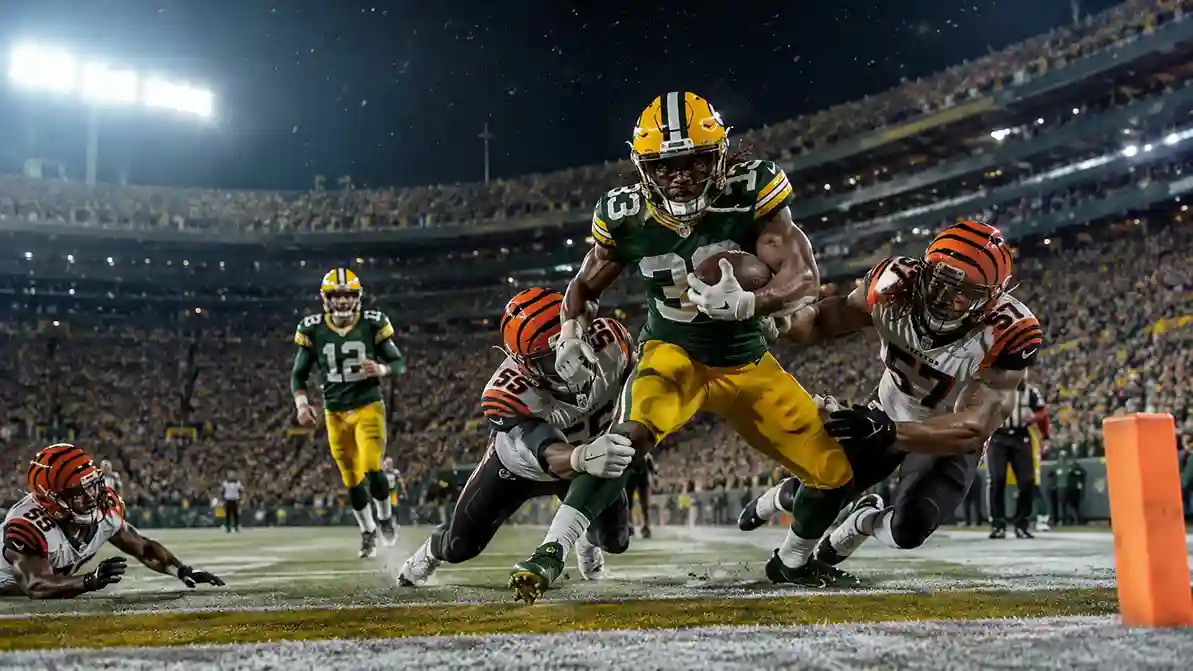
- Jacobs’ second touchdown, a 14-yard burst up the middle, extended the lead to 17-7 to start the quarter.
- Evan McPherson answered with a 45-yard field goal to make it 17-10.
- Love found Kraft for a 19-yard touchdown to push it to 24-10.
- Flacco hit Chase for a fourth-and-5, 19-yard touchdown and converted the two-point try to Chase Brown, trimming it to 24-18 with 4:11 left.
- Havrisik’s second field goal of the night, a 39-yarder with 1:52 remaining, sealed the 27-18 final.
Green Bay Packers Player Statistics
Jordan Love — QB 19/26, 259 yards, 1 TD, 0 INT
Love didn’t need volume — his 9.8 yards-per-attempt average came from a handful of explosive completions, and his fourth-quarter touchdown to Kraft proved to be the decisive score.
Josh Jacobs — RB 93 rushing yards, 2 rushing TD (150 total yards from scrimmage)
Jacobs scored both Green Bay touchdowns and was the engine of the ground game all afternoon, reportedly playing through flu symptoms throughout the contest.
Matthew Golden — WR 3 receptions, 86 yards; 16 rushing yards on 2 carries
The rookie was Green Bay’s big-play outlet, with catches of 35, 31, and 20 yards plus a pair of end-around runs that kept the Bengals’ defense off balance.
Tucker Kraft — TE 1 reception, 19 yards, 1 TD
A single target, but it was the one that mattered most — a fourth-quarter score that pushed the lead to two possessions.
Cincinnati Bengals Player Statistics
Joe Flacco — QB 29/45, 219 yards, 2 TD, 0 INT, sacked once (90.9 rating)
In his first start under center for Cincinnati, Flacco threw for two touchdowns and nearly engineered a fourth-quarter comeback, but the Bengals’ slow start left too much to do.
Ja’Marr Chase — WR 10 receptions, 94 yards, 1 TD (12 targets)
Chase was targeted more than any other player in the game and delivered the Bengals’ final touchdown on a fourth-down conversion.
Tee Higgins — WR 5 receptions, 62 yards
A steady complementary threat opposite Chase, Higgins moved the chains on several third-down and red-zone situations.
Chase Brown — RB 42 rushing yards on 9 carries; 2 receptions for 7 yards
Brown led a Bengals run game that managed only 3.4 yards per carry against a stout Packers front.
Statistical Leaders Summary
| Category | Bengals | Packers |
| Leading Passer | Joe Flacco (219 yds, 2 TD) | Jordan Love (259 yds, 1 TD) |
| Leading Rusher | Chase Brown (42 yds) | Josh Jacobs (93 yds, 2 TD) |
| Leading Receiver | Ja’Marr Chase (94 yds, 1 TD) | Matthew Golden (86 yds) |
| Sacks | Geno Stone (1.0) | Lukas Van Ness (1.0) |
Why the Packers Won
Balanced, Big-Play Offense
Green Bay didn’t need to out-attempt Cincinnati — it needed to out-gain it. The Packers’ 6.8 yards per play to the Bengals’ 4.3 meant fewer snaps produced more yardage and, ultimately, more points.
| Category | Bengals | Packers |
| Yards per Play | 4.3 | 6.8 |
| Yards per Pass Attempt | 4.7 | 9.8 |
| Yards per Rush | 3.4 | 4.6 |
Josh Jacobs’ Workhorse Performance
Two rushing touchdowns from a back reportedly dealing with illness gave Green Bay a physical edge Cincinnati couldn’t match on the ground.
Controlling the Clock
Holding the ball for 32:44 against a Bengals offense that scored on 11 points in the fourth quarter kept Cincinnati’s comeback bid from ever getting enough possessions to complete it.
Why the Bengals Lost
A Run Game That Never Got Going
Cincinnati’s backs combined for just 55 yards on the ground, which put the offense in more third-and-long situations than a first-time starting quarterback needed to face.
Falling Behind Early
Cincinnati didn’t score until the third quarter, and playing from a 10-point hole for most of the game forced Flacco into obvious passing situations the Packers’ pass rush could tee off on.
Historical Context and Advanced Insights
Previous Meeting: Because Green Bay and Cincinnati sit in different conferences, they meet only once every few seasons on the NFL’s rotating schedule — there’s no multi-game season series to speak of. Their last matchup before this one came on October 10, 2021, a game Green Bay also won, 25-22 in overtime.
Drive Efficiency: The advanced story of this game is in scoring-drive efficiency rather than raw play count. Green Bay’s touchdown drives averaged roughly 10 yards per play (an 8-play, 80-yard march and a 6-play, 62-yard march both finished in the end zone), while Cincinnati’s lone touchdown drive before the fourth quarter took 17 plays to cover 78 yards.
Green Bay simply needed fewer snaps to find the end zone, which is the clearest explanation for a 141-yard total-offense gap despite a fairly even time-of-possession battle in the first half.
What This Means for the Packers
- A 3-1-1 start shows the offense can win multiple ways — through Love’s arm on early downs and Jacobs’ legs in short yardage.
- Golden’s emergence as a big-play threat gives Love a second explosive option alongside the run game.
- Winning while giving up a turnover and playing a below-average third quarter suggests a team with margin for error.
What This Means for the Bengals
- Flacco’s two-touchdown relief effort was encouraging, but the offense needs a functioning run game to take pressure off him.
- Falling behind 10-0 by halftime for the second time in as many weeks points to a slow-starting offense that needs fixing.
- Allowing 409 total yards and 6.8 per play is a mark the defense will need to clean up against more efficient offenses.
Key Lessons
- Efficiency (yards per play) can matter more than total plays run.
- A workhorse back scoring twice can offset a giveaway elsewhere on the stat sheet.
- Long, grinding scoring drives leave less room for error than quick-strike ones.
- Slow starts are hard to overcome even with a big fourth quarter.
- Time of possession matters most when paired with scoring efficiency, not in isolation.
- A committee running game without a lead back can stall an offense regardless of the passing numbers around it.
Frequently Asked Questions
Who won the Packers vs Bengals game? The Green Bay Packers won 27-18 over the Cincinnati Bengals on October 12, 2025, at Lambeau Field.
Who led the Packers in passing? Jordan Love went 19-of-26 for 259 yards and a touchdown.
How many touchdowns did Josh Jacobs score? Two rushing touchdowns, both while reportedly playing through flu symptoms.
Who was Cincinnati’s leading receiver? Ja’Marr Chase, with 10 catches for 94 yards and a touchdown on 12 targets.
What was the attendance for the game? 78,277 fans at Lambeau Field.
Was this Joe Flacco’s first start at quarterback for the Bengals? Yes, this Week 6 game marked his first start under center for Cincinnati.
Conclusion
The final score suggests a comfortable Packers win, but the underlying stats show a game decided by efficiency rather than dominance. Green Bay turned fewer plays into more yards, got a workhorse effort out of Josh Jacobs, and leaned on two explosive pass-catchers to finish drives Cincinnati’s defense couldn’t stop.
The Bengals had real individual production from Flacco and Chase, but a stalled run game and a slow start to the scoreboard left too much ground to make up.