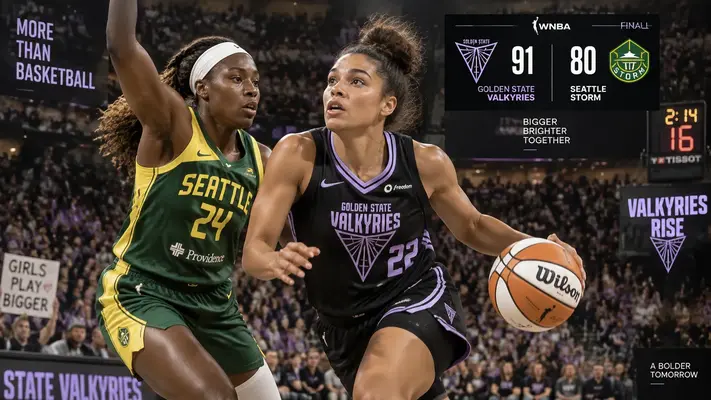
Season openers rarely settle anything, but they reveal plenty. If you’re searching for golden state valkyries vs seattle storm match player stats, you already know the headline: Golden State walked into Climate Pledge Arena and shot the Storm out of their own building. Seattle actually led after one quarter. Then the Valkyries answered with a barrage from deep that Seattle never solved.
The Lead
The Golden State Valkyries opened their 2026 season on the road Friday night, May 8, at Climate Pledge Arena in Seattle, and left with a 91-80 win over the Storm. Seattle actually took an early edge, outscoring Golden State 24-23 in the first quarter, but a 26-17 second-quarter surge from the Valkyries flipped the game and set the tone for the rest of the night.
Golden State finished the night shooting 41 percent from three-point range on 37 attempts, a total driven largely by a reserve who wasn’t even in the starting five. Janelle Salaün came off the bench to score 20 points on 7-of-16 shooting, tying her career high with five made threes, while Veronica Burton ran the offense with 16 points and a game-high six assists. Seattle got a strong individual performance from rookie center Dominique Malonga, who posted 21 points and eight rebounds, but the Storm couldn’t generate consistent secondary scoring until a fourth-quarter rally that came too late.
Match Overview
| Information | Match Details |
| Event | WNBA Regular Season – 2026 Season Opener |
| Game | Golden State Valkyries vs Seattle Storm |
| Date | Friday, May 8, 2026 |
| Venue | Climate Pledge Arena, Seattle, WA |
| Attendance | Not officially listed in the game box score |
| Winner | Golden State Valkyries |
| Final Score | 91-80 |
| Broadcast | ION |
Core Match Statistics Overview
The box score tells a clear story: Golden State shot better from every range that mattered, while Seattle actually won the battle on the glass and got to the free-throw line more often.
| Stat | Golden State Valkyries | Seattle Storm |
| Field Goal % | 42% (31-74) | 41% (26-63) |
| Three-Point % | 41% (15-37) | 35% (9-26) |
| Free Throw % | 64% (14-22) | 70% (19-27) |
| Rebounds | 35 | 41 |
| Assists | 22 | 16 |
| Turnovers | 9 | 14 |
| Steals | 5 | 4 |
| Blocks | 5 | 5 |
Three-Point Shooting
- Golden State drained 15 threes on 37 attempts, powered almost entirely by Salaün’s five makes and Burton’s two.
- Seattle shot just 35% from deep and needed 26 attempts to get to nine makes, a gap of six percentage points that was the single biggest separator in the box score.
Ball Movement
- The Valkyries finished with 22 assists against only 9 turnovers, an assist-to-turnover ratio that shows how controlled their half-court offense was.
- Seattle’s 14 turnovers against 16 assists reflects a much shakier ball-handling night, and those extra live-ball giveaways turned directly into transition points for Golden State.
Rebounding and Second-Chance Opportunities
- Seattle out-rebounded Golden State 41-35 and grabbed 13 offensive boards, keeping several possessions alive that the Valkyries would otherwise have closed out.
- Despite the rebounding deficit, Golden State’s efficiency from the field meant Seattle’s extra possessions rarely translated into extra points.
Free Throw Trips
- Seattle shot 27 free throws to Golden State’s 22, converting at a better 70% clip, which kept the Storm within range in the fourth quarter.
- Golden State’s lower free-throw percentage (64%) was one of the few statistical categories where the Valkyries were outplayed.
Period-by-Period Analysis
| Quarter | Golden State | Seattle |
| Q1 | 23 | 24 |
| Q2 | 26 | 17 |
| Q3 | 20 | 12 |
| Q4 | 22 | 27 |
| Final | 91 | 80 |
- Seattle came out sharp, using early buckets from Dominique Malonga and Flau’jae Johnson to grab a one-point edge after the first 10 minutes — the only quarter the Storm actually won outright.
- The second and third quarters belonged entirely to Golden State. The Valkyries outscored Seattle 46-29 across that stretch, with Salaün’s threes and Burton’s playmaking pulling the game out of reach heading into the fourth.
- Seattle mounted a real push in the final period, outscoring Golden State 27-22 behind Zia Cooke and Jade Melbourne off the bench, but the 20-point cushion built over the middle two quarters was too much to erase.
Golden State Valkyries Player Statistics
Janelle Salaün — 27 MIN, 20 PTS, 7-16 FG, 5-11 3PT, 1-3 FT, 2 REB, 1 AST, 1 BLK Salaün came off the bench and immediately became the offensive engine, tying her career high with five three-pointers and finishing as the game’s leading scorer. Her outside shooting single-handedly stretched Seattle’s defense for the entire second half.
Veronica Burton — 31 MIN, 16 PTS, 5-13 FG, 2-4 3PT, 4-5 FT, 2 REB, 6 AST, 2 STL Burton controlled tempo from the point, leading all players with six assists while also knocking down two threes of her own. Her decision-making kept Golden State’s ball movement clean all night, evidenced by the team’s low turnover count.
Kaitlyn Chen — 16 MIN, 14 PTS, 5-10 FG, 2-3 3PT, 2-2 FT Chen provided instant offense off the bench, hitting half her field-goal attempts and adding another layer to Golden State’s three-point attack. Her efficiency in limited minutes gave the Valkyries bench a scoring edge Seattle never matched.
Kayla Thornton — 30 MIN, 13 PTS, 4-9 FG, 3-6 3PT, 2-2 FT, 8 REB Thornton anchored the starting lineup with a team-high eight rebounds while also stepping outside to knock down three triples. Her two-way presence set the tone defensively while still contributing to the perimeter barrage.
Seattle Storm Player Statistics
Dominique Malonga — 29 MIN, 21 PTS, 8-15 FG, 0-2 3PT, 5-9 FT, 8 REB, 2 BLK Malonga was Seattle’s most productive player by a wide margin, matching Golden State’s leading rebounder with eight boards of her own while scoring efficiently inside. She was one of the few Storm starters who consistently found ways to score against Golden State’s length.
Zia Cooke — 23 MIN, 15 PTS, 5-12 FG, 2-3 3PT, 3-5 FT, 7 REB, 2 AST Cooke was the catalyst behind Seattle’s fourth-quarter push, scoring 15 points and grabbing seven rebounds off the bench. Her second-half aggressiveness kept the Storm within striking distance longer than the first three quarters suggested was possible.
Jade Melbourne — 17 MIN, 13 PTS, 4-5 FG, 2-3 3PT, 3-3 FT, 3 AST Melbourne was nearly perfect from the field, converting four of five attempts and adding a pair of threes in a compact 17-minute outing. Her efficiency off the bench was a bright spot in an otherwise inefficient shooting night for Seattle.
Flau’jae Johnson — 26 MIN, 12 PTS, 3-12 FG, 3-7 3PT, 3-3 FT Johnson struggled with efficiency, needing 12 shots to get to 12 points, though all of her field goals beyond three-point range came at the free-throw line. Her volume shooting reflected Seattle’s broader struggle to generate easy looks against Golden State’s defense.
Statistical Leaders Summary
| Category | Golden State Valkyries | Seattle Storm |
| Leading Scorer | Janelle Salaün (20) | Dominique Malonga (21) |
| Second Leading Scorer | Veronica Burton (16) | Zia Cooke (15) |
| Top Rebounder | Kayla Thornton (8) | Dominique Malonga (8) |
| Most Assists | Veronica Burton (6) | Three tied with 3 (Dolson, Hiedeman, Melbourne) |
Why Golden State Won
Bench Scoring Advantage
Golden State’s reserves — Salaün, Chen, and Cecilia Zandalasini among them — combined for a significant chunk of the team’s 91 points, giving the Valkyries a scoring source Seattle’s bench simply couldn’t match on this particular night.
Elite Three-Point Volume and Accuracy
| Metric | Golden State | Seattle |
| 3PT Made | 15 | 9 |
| 3PT Attempted | 37 | 26 |
| 3PT % | 41% | 35% |
Golden State attempted 11 more threes than Seattle and still shot a higher percentage, a combination that’s difficult for any defense to overcome across a full 40 minutes.
Turnover Discipline
| Metric | Golden State | Seattle |
| Turnovers | 9 | 14 |
| Assists | 22 | 16 |
Nine turnovers against 22 assists is an exceptionally clean offensive performance, and it meant Seattle rarely got the extra transition possessions that come from live-ball takeaways.
Why Seattle Lost
Cold Stretch Through the Middle Two Quarters
Seattle scored just 29 combined points across the second and third quarters while Golden State scored 46, and that 27-minute stretch decided the outcome of the game well before the fourth-quarter rally began.
Heavy Dependence on Malonga and Cooke Late
Outside of Malonga’s 21 and Cooke’s 15, Seattle’s remaining rotation combined for modest scoring totals in single digits or low double digits each, leaving too much of the offensive burden on two players once the Valkyries built their cushion.
Season Series and Advanced Insights
Season Series Breakdown
| Game | Result | Score |
| Game 1 (at Seattle) | Golden State win | 91-80 |
| Game 2 (at Seattle) | Golden State win | 76-72 |
| Game 3 (at Golden State) | Scheduled — Prime Video | — |
Golden State entered the season holding a 2-0 edge in the head-to-head series against Seattle, with the third meeting set to take place at Golden State’s home venue.
Assist-to-Turnover Efficiency
Golden State’s 22 assists against 9 turnovers works out to an assist-to-turnover ratio near 2.4-to-1, a mark that reflects genuinely controlled half-court execution rather than one hot shooting stretch. Seattle’s corresponding ratio sits closer to 1.1-to-1, meaning nearly every assisted basket the Storm generated was matched by a giveaway elsewhere on the floor. That gap, more than any single player’s box score line, explains why Golden State’s offense felt so difficult to disrupt once it found rhythm in the second quarter.
Game Implications and Key Lessons
What This Means for Golden State
- A season-opening road win against a Western Conference opponent is a strong early confidence marker.
- The bench scoring shown by Salaün and Chen gives the coaching staff a reliable second unit to lean on.
What This Means for Seattle
- The Storm need more consistent perimeter shooting beyond Malonga and Cooke to keep pace with three-point-heavy opponents.
- Cutting down turnovers will be a clear priority after a 14-turnover night against a disciplined Golden State defense.
Key Lessons
- Three-point volume paired with accuracy is difficult to overcome even when the opposing team wins the rebounding battle.
- Bench production can swing a game as much as starter performance, as shown by Salaün’s 20-point outing.
- Assist-to-turnover ratio is often a better predictor of offensive control than raw scoring totals.
- A strong start doesn’t guarantee a win if the middle quarters go cold, as Seattle experienced in the second and third periods.
- Free-throw shooting alone can’t offset a wide gap in three-point efficiency.
- Individual double-digit rebounding performances, like Malonga’s, matter less when the supporting cast can’t convert efficiently.
Frequently Asked Questions
Who won the Golden State Valkyries vs Seattle Storm game?
The Golden State Valkyries won 91-80 on the road at Climate Pledge Arena on May 8, 2026.
Who scored the most points in the game?
Dominique Malonga led all scorers with 21 points for Seattle, while Janelle Salaün led Golden State with 20 points.
What were Janelle Salaün’s stats in the game?
Salaün finished with 20 points on 7-of-16 shooting, including five made three-pointers on 11 attempts, tying her career high.
How many three-pointers did Golden State make?
Golden State made 15 three-pointers on 37 attempts, shooting 41% from beyond the arc for the game.
Who led Golden State in assists?
Veronica Burton led all players in the game with six assists, to go along with 16 points.
Did Seattle lead at any point in the game?
Yes, Seattle led after the first quarter, 24-23, before Golden State outscored the Storm 46-29 across the second and third quarters.
Conclusion
This game came down to shot quality over shot volume. Seattle actually won the rebounding battle and got to the free-throw line more often, but none of that mattered against a Golden State team that made 41% of its threes on high volume while protecting the basketball at a nine-turnover clip.
Malonga’s 21-point, eight-rebound night was a genuine individual highlight for Seattle, but one strong performance couldn’t offset the collective efficiency Golden State showed across its starting five and bench alike.