Cleveland Cavaliers vs Boston Celtics Match Player Stats: Jaylen Brown Leads Celtics to Blowout Victory
Two of the East’s top contenders collided at TD Garden, and the box score tells a story of exactly how a slow start can unravel against a team that never stops moving the ball. If you’re searching for the full breakdown of this cleveland cavaliers vs boston celtics match player stats sheet, you’re in the right place — every quarter, every shooting split, and every player line from this Eastern Conference clash is broken down below. Boston’s role players outproduced Cleveland’s stars, and that’s the whole ballgame.
The Lead
The Boston Celtics hosted the Cleveland Cavaliers on Wednesday, October 29, 2025, at TD Garden in Boston, in front of a sellout crowd of 19,156. What looked like a coin-flip matchup through one quarter turned into a rout by the final horn, with Boston pulling away 125-105 to snap Cleveland’s three-game winning streak. Jaylen Brown paced all scorers with 30 points, and the Celtics got tremendous depth off the bench from Sam Hauser and Neemias Queta to bury the Cavaliers under a wave of second-unit production.
Cleveland actually led after the first quarter behind a red-hot Donovan Mitchell, who drilled all four of his three-point attempts in the opening frame. But a 20-3 run to close the first half flipped the game on its head, and Boston never trailed again. By the time the buzzer sounded, eight different Celtics had scored in double figures, while Cleveland leaned almost entirely on Evan Mobley and Jaylon Tyson to keep pace. This game is a clean case study in why Boston Celtics player stats this season keep pointing to depth as the separator between the two rosters.
Match Overview Table
| Information | Match Details |
| Event | NBA Regular Season, 2025-26 |
| Game | Cleveland Cavaliers vs Boston Celtics |
| Date | Wednesday, October 29, 2025 |
| Venue | TD Garden, Boston, MA |
| Attendance | 19,156 (sellout) |
| Winner | Boston Celtics |
| Final Score | Celtics 125, Cavaliers 105 |
| Broadcast | ESPN, NBC Sports Boston, FanDuel Sports Network Ohio |
Core Match Statistics Overview
Looking at the full Cleveland Cavaliers vs Boston Celtics box score, the gap wasn’t about one dominant shooting night — it was about volume, second chances, and free possessions.
| Team Stat | Cleveland Cavaliers | Boston Celtics |
| Field Goals | 35-87 (40.2%) | 42-95 (44.2%) |
| 3-Point FG | 17-52 (32.7%) | 21-57 (36.8%) |
| Free Throws | 18-24 (75.0%) | 20-24 (83.3%) |
| Total Rebounds | 42 | 53 |
| Offensive Rebounds | 11 | 18 |
| Turnovers | 14 | 9 |
| Points Off Turnovers | 14 | 19 |
| Fast Break Points | 19 | 13 |
| Points in the Paint | 28 | 34 |
| Personal Fouls | 22 | 19 |
Three-Point Shooting
- Boston out-attempted Cleveland from deep, 57 to 52, and still shot a better percentage (36.8% to 32.7%), a rare double advantage in both volume and efficiency.
- Cleveland actually won the first-quarter three-point battle behind Mitchell’s perfect 4-for-4 start, but couldn’t sustain it once Boston’s role players caught fire.
Rebounding Battle
- Boston’s 53 rebounds against Cleveland’s 42 gave the Celtics a 11-rebound edge, with a jaw-dropping 18 offensive boards fueling extra possessions.
- Josh Minott and Neemias Queta combined for 27 rebounds off the bench alone, more than Cleveland’s entire starting frontcourt produced.
Ball Security and Extra Possessions
- Cleveland’s 14 turnovers against Boston’s 9 handed the Celtics five additional possessions, and Boston cashed those in for 19 points off turnovers compared to Cleveland’s 14.
- Boston’s offensive rebounding plus its turnover advantage created a possession gap that Cleveland simply couldn’t out-shoot.
Interior Scoring
- Boston out-scored Cleveland in the paint, 34-28, despite Cleveland starting two skilled bigs in Evan Mobley and Jarrett Allen.
- Cleveland’s 19 fast-break points were actually the game’s one clear category win, but it wasn’t nearly enough volume to offset Boston’s half-court advantages elsewhere.
Period-by-Period Analysis
First Quarter: Cavaliers Set the Pace
| Team | Q1 Score |
| Cleveland Cavaliers | 42 |
| Boston Celtics | 40 |
- Donovan Mitchell opened the game red-hot, making all four of his three-point attempts for 12 first-quarter points.
- The two teams combined for 18 made three-pointers in the frame alone, one shy of tying an NBA record for a single quarter.
- Despite trailing for most of the period, Boston stayed within striking distance thanks to Payton Pritchard’s playmaking and a string of putback buckets from Neemias Queta.
Second Quarter: The 20-3 Run That Changed Everything
| Team | Q2 Score |
| Cleveland Cavaliers | 18 |
| Boston Celtics | 35 |
- Cleveland briefly extended its lead to 57-55 with four minutes left in the half before the wheels came off completely.
- Boston closed the half on a 20-3 run, with Jaylen Brown scoring 13 of his eventual 30 points down the stretch, including a buzzer-beating step-back three.
- The Celtics finished the half with 20 team assists, a clear signal that ball movement, not isolation scoring, was driving the surge.
Third Quarter: Boston Extends the Cushion
| Team | Q3 Score |
| Cleveland Cavaliers | 25 |
| Boston Celtics | 23 |
- Boston pushed its lead to a game-high 19 points midway through the quarter, with a 22-5 scoring run over less than five minutes.
- Cleveland showed some fight late, scoring eight straight points in the final two minutes, but never got closer than nine.
- Jaylen Brown and Derrick White combined to keep answering every Cleveland mini-run with quick buckets in transition and off screens.
Fourth Quarter: Cleveland Chips Away, Too Little Too Late
| Team | Q4 Score |
| Cleveland Cavaliers | 20 |
| Boston Celtics | 27 |
- Cleveland shot just 33% (8-for-24) in the final period, unable to string together enough stops to mount a real comeback.
- Payton Pritchard took over as a scorer late, adding a pullup jumper and a driving layup to push the margin to 20 points.
- Boston closed the door with disciplined free-throw shooting and continued to share the ball, with Sam Hauser’s late three effectively ending any faint hope of a Cleveland rally.
Boston Celtics Player Statistics
| Player | Points | Rebounds | Assists | Shooting |
| Jaylen Brown | 30 | 5 | — | 12-20 FG, 4-9 3PT |
| Sam Hauser | 21 | — | — | 7-12 3PT |
| Derrick White | 19 | 5 | 4 | — |
| Payton Pritchard | 10 | — | 10 | — |
Jaylen Brown was the engine of Boston’s win, attacking downhill early and then turning into a knockdown shooter late, drilling a 31-footer and a step-back buzzer-beater to close the first half. His 12-for-20 shooting night showed both efficiency and volume, exactly the kind of two-way scoring punch that swings a game this lopsided.
Sam Hauser gave Boston a bench weapon that Cleveland had no answer for, connecting on 7 of 12 three-point attempts for 21 points off the pine. His floor-spacing forced Cleveland’s defense to stretch thin, opening driving lanes for Brown and White all night.
Derrick White quietly stuffed the stat sheet with 19 points, five boards, and four assists, providing steady two-way play that never let Cleveland settle into a defensive rhythm. His three-point shooting down the stretch of the first half was a key piece of the 20-3 closing run.
Payton Pritchard ran the offense with poise, finishing with 10 assists to go with 10 points, repeatedly finding cutters and shooters for easy buckets. His playmaking is a big reason Boston posted such a strong assist number in the first half alone.
Beyond the top four, Josh Minott (11 points, 14 rebounds), Neemias Queta (10 points, 13 rebounds), and Luka Garza (10 points) rounded out eight Celtics in double figures — a genuine team-wide effort.
Cleveland Cavaliers Player Statistics
| Player | Points | Rebounds | Assists | Shooting |
| Evan Mobley | 19 | 11 | — | 7-19 FG, 2-8 3PT |
| Jaylon Tyson | 19 | — | — | 8-11 FG, 2-5 3PT |
| Jarrett Allen | 16 | 6 | — | — |
| Donovan Mitchell | 15 | — | 6 | 5-12 FG, 5-9 3PT |
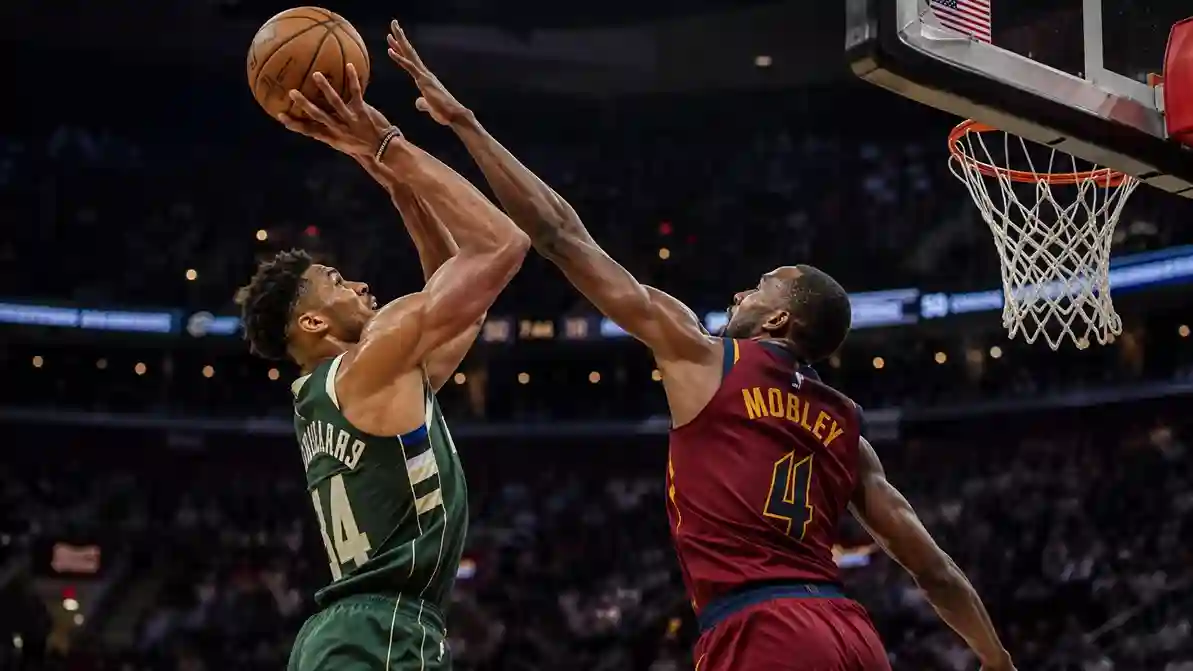
Evan Mobley delivered a near double-double with 19 points and 11 rebounds, but needed 19 shot attempts to get there, an inefficiency that reflects how well Boston’s frontcourt contested his looks in the paint.
Jaylon Tyson was Cleveland’s most efficient scorer, matching Mobley’s 19 points on just 11 field-goal attempts, a much cleaner shooting clip that hints at real long-term upside for the young wing.
Jarrett Allen provided steady interior scoring with 16 points and 6 rebounds, but was often forced away from the basket by Boston’s switch-heavy defensive coverage.
Donovan Mitchell made every one of his first four three-point attempts for a scorching start, but the Celtics adjusted quickly, holding him to just one make on his final eight shots and a modest 15-point, 6-assist final line — a stark before-and-after in the Cleveland Cavaliers player stats column.
Statistical Leaders Summary Table
| Category | Cleveland Cavaliers | Boston Celtics |
| Leading Scorer | Evan Mobley (19) | Jaylen Brown (30) |
| Second Leading Scorer | Jaylon Tyson (19) | Sam Hauser (21) |
| Top Rebounder | Evan Mobley (11) | Josh Minott (14) |
| Most Assists / Playmaker | Donovan Mitchell (6) | Payton Pritchard (10) |
Why the Celtics Won
Balanced Offensive Production
Eight Celtics scored in double figures, an offensive spread that made it impossible for Cleveland’s defense to key on any single player. Compare that to Cleveland, where only four players cracked double digits and the offense visibly stalled whenever Mobley or Tyson had an off possession.
| Category | Cleveland Cavaliers | Boston Celtics |
| Players in Double Figures | 4 | 8 |
| Bench Points (est. from box) | Modest | Heavy (Hauser, Minott, Queta, Garza) |
Second-Chance Dominance
Boston’s 18 offensive rebounds against Cleveland’s 11 created extra possessions all night long, a category where the Celtics simply out-worked the Cavaliers on the glass. That rebounding margin is one of the clearest predictors of blowout wins in the modern NBA, and it showed up here in a big way.
Feeding Off Cleveland’s Mistakes
Boston forced 14 Cleveland turnovers and turned them into 19 points, while committing only 9 turnovers of its own. That +5 turnover margin, paired with the rebounding edge, gave the Celtics several more scoring chances across the 48 minutes than Cleveland ever had.
Why the Cavaliers Lost
Heavy Dependence on Two Players
Mobley and Tyson combined for 38 of Cleveland’s 105 points, more than a third of the team’s total offense. When Boston’s defense tightened in the second and third quarters, Cleveland had no reliable third or fourth scoring option to lean on.
Donovan Mitchell’s Cold Stretch
After his blistering 12-point first quarter, Mitchell made just 1 of his final 8 shot attempts. A star-level cold streak at exactly the moment Boston began its run was the single biggest swing factor in the game.
Turnover and Rebounding Deficits
Cleveland’s 14 turnovers and its 11-rebound deficit compounded across four quarters, and by the fourth quarter, the Cavaliers were shooting just 33% while trying to force the issue against a set Boston defense.
Historical Context & Advanced Insights
Season Series Breakdown
| Meeting | Date | Result |
| Game 1 | October 12, 2025 | Celtics won 138-107 |
| Game 2 | October 29, 2025 | Celtics won 125-105 |
Boston has taken firm control of the early-season series, sweeping the first two meetings by a combined 51 points. Both wins have followed a similar blueprint: Cleveland keeps things competitive in stretches, but Boston’s depth and ball movement eventually pull the game away.
Advanced Statistical Insights
Boston’s assist totals relative to its field goals made tell the deeper story here. With 20 assists in the first half alone and a offense built around cutting, screening, and quick decision-making, the Celtics generated a far higher assist-to-field-goal ratio than Cleveland’s more iso-heavy attack.
Cleveland’s offense, by contrast, produced strong isolation numbers from Mitchell and Mobley but lacked the connective passing that turns good shots into great ones. That gap in ball movement efficiency is often a stronger predictor of sustained scoring runs than raw shooting percentage, and it’s exactly why Boston’s 20-3 closing run to the first half felt so inevitable in hindsight.
Cleveland’s 40.2% shooting from the field against Boston’s 44.2% is a modest four-point gap, but layered on top of an 11-rebound deficit and a five-turnover swing, the cumulative possession math explains the final 20-point margin far better than shooting numbers alone.
Game Implications & Key Lessons
What This Means for Boston
- The win moved the Celtics to 2-3 on the young season after an 0-3 start, showing the roster’s depth can carry them through stretches when the stars aren’t dominant individually.
- Eight players scoring in double figures is a strong sign of offensive system health heading into a tougher November stretch.
- Confidence from a 20-point win over a conference contender should carry real weight in Boston’s locker room.
What This Means for Cleveland
- Cleveland’s three-game winning streak snapped, and the loss exposed real concerns about bench scoring depth beyond the starting group.
- Donovan Mitchell’s shooting variance late in games is worth monitoring, especially against switch-heavy defenses like Boston’s.
- The Cavaliers need more consistent rebounding effort from their frontcourt if they hope to close the door on quality opponents.
Key Lessons
- Bench scoring depth often decides games between otherwise evenly matched contenders.
- Offensive rebounding is one of the most reliable ways to manufacture extra scoring chances.
- A hot shooting start does not guarantee a full 48-minute performance; defenses adjust.
- Turnover margin compounds quickly across four quarters into a real point differential.
- Ball movement and assist totals often predict sustained scoring runs better than isolated star performances.
- Balanced scoring attacks are far harder for opposing defenses to game-plan against than top-heavy lineups.
Frequently Asked Questions
Who won the Cavaliers vs Celtics game on October 29, 2025?
The Boston Celtics won 125-105 over the Cleveland Cavaliers at TD Garden.
Who led all scorers in the game?
Jaylen Brown led all scorers with 30 points on 12-for-20 shooting, including 4-for-9 from three-point range.
What were Donovan Mitchell’s stats in this game?
Donovan Mitchell finished with 15 points on 5-for-12 shooting (5-for-9 from three), along with 6 assists, after a hot 12-point first quarter cooled off significantly in the second half.
How many rebounds did Evan Mobley have?
Evan Mobley recorded 19 points and 11 rebounds on 7-for-19 shooting for the Cavaliers.
What was the turning point of the game?
Boston’s 20-3 run to close the first half, capped by back-to-back three-pointers from Jaylen Brown, turned a close game into a runaway Celtics lead.
Is this the first meeting between these two teams this season?
No, this was the second meeting of the 2025-26 season. Boston also won the first matchup on October 12, 2025, by a score of 138-107.
Conclusion
This game boiled down to a simple truth: efficient, team-wide offense beats star-heavy scoring when the role players show up. Boston’s eight double-figure scorers, its rebounding edge, and its disciplined ball movement overwhelmed a Cleveland attack that leaned too heavily on Evan Mobley, Jaylon Tyson, and an inconsistent night from Donovan Mitchell.
The Celtics’ depth advantage was the real story of the box score, and it’s a blueprint they’ll look to repeat as the season progresses.